
Craft resins
Our Craft series of pens is a showcase of the traditional crafts which help form the cultural history of Japan. These first two entries into the series use resin as their main medium, with some unconventional colouring agents.
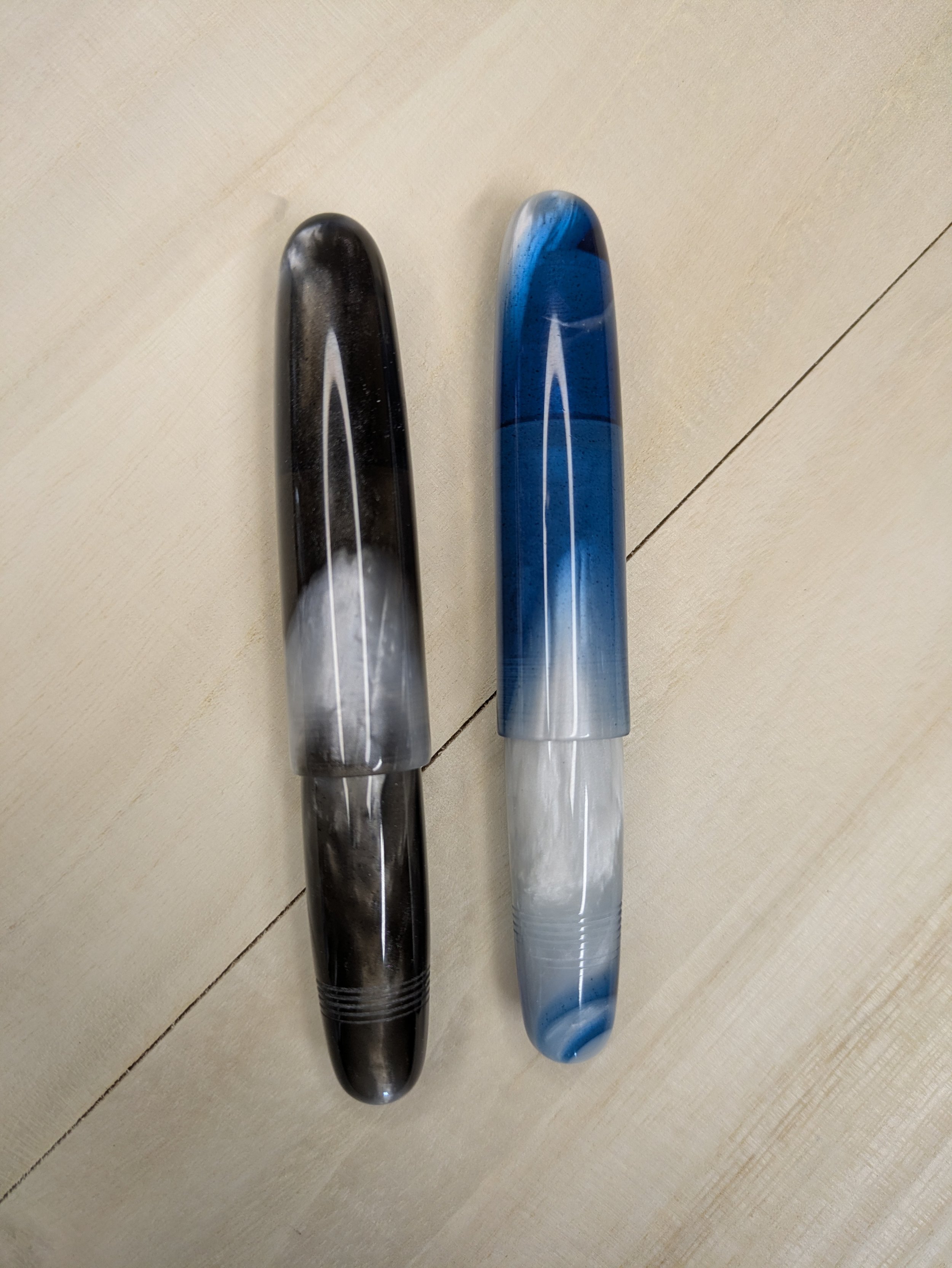
Craft Ink
Sumi is a traditional ink stick made primarily from soot which is used in a lot of art forms in eastern asia - from calligraphy to watercolour, ukiyo-e paintings and even modern art, Sumi ink is an immediately recognizable part of Japanese writing culture even today.
Sumi ink comes in a hard stick form. In order to use the ink, it must be ground against a special ink stone using water as a medium. The grinding of the ink stick is part of the process of creating art, and the artist/calligrapher must maintain pressure and constantly monitor the mixture for colour and viscosity.
Mirroring this process, we hand-grind the ink stick using a special medium with a traditional Japanese mortar and pestle. It is an extremely simple process, but it takes time and concentration. Just because it is simple does not mean it is easy.
The result is not just an ‘inky’ black but a true ink black which is slightly transparent. Poured alongside a contrasting white opaque resin, to mimic the interplay of ink and paper, the contrasting opacities of the materials let you see the current and flow of resin in the pen.
For us, this pen encapsulates the careful contemplation and preparation necessary before undertaking writing or drawing.
Craft Indigo
Those familiar with fabrics and dyes will undoubtedly have heard of Aizome. Aizome is the name of traditional Japanese indigo dye and the practice of dying itself in a tradition which dates back over 1000 years. Using natural ingredients, dyers of antiquity were able to create vivid, dazzling blues in fabrics used in all walks of life - from rich kimono, to decorative hangings, to the rough practical work aprons and clothes of tradesmen, Aizome has had an impact on the visual identity of the country.
To create patterns and designs, some parts of the fabric folded, tied, or dipped to prevent the indigo dye from penetrating some of the fibres when the work was dipped into the dying vat, and as a result the undyed portions would remain white. Blue and white, mirroring the sky and clouds thusly became connected in Aizome dying practices.
We obtain a dye compound from a manufacturer that has been in continuous operation in Japan for over 200 years, producing dye and dyed goods. Much like our Craft Ink resin, we then hand-grind the dye compound using a mortar and pestle and special media until a beautiful blue is achieved, and mix this with a cloudy white resin.
If you look very closely, you can see tiny (less than 1 micron) particles of the dye compound in the pen, giving it a lovely speckled look. The resin is both dyed, and contains raw dye!